YouTube Posting Schedule: One Asset, Many Outputs (The FailArmy System)
Ten videos in, and the most toxic question in this business
A friend messaged me one evening. He had just published his tenth video. The message was one line long: “Maybe I’m just not cut out for this?”
I knew that evening intimately, because I lived inside it for about four years.
The refreshing. Hitting reload on the analytics page as though wanting it badly enough would manufacture viewers. The number sitting perfectly still. And then that question starting up in your head, the one I consider the single most destructive thought in this line of work: maybe I don’t have what it takes.
Here is what took me years to admit. I was not short on ability. I was short on a process. Every video was a bet. I poured everything into it, deflated when it flopped, took two weeks off because I was demoralised, then forced myself into the next one. Eventually I understood that “maybe I’m not cut out for this” is the wrong question entirely. It sends you hunting for one genius video when the actual problem sits somewhere else.
The worst thing you can hand the YouTube algorithm is not a mediocre video. It is silence. The system does not dislike you; it forgets you when you stop giving it things to test. My mistake, and my friend’s, was waiting for one upload to carry an entire career. The job is to have thirty of them working at once.
So in this piece I want to open up a machine that actually exists, a channel people mistake for magic, and show you why its millions of views are not luck. They come out of a system: one asset, many outputs. And a system can be learned.
Why a million views is the baseline: reading the upload rhythm
The channel is FailArmy, created on July 5, 2011, so it is nearly fifteen years old. In that time it has gathered 17.5 million subscribers across 991 videos, totalling roughly 4.965 billion views. But the number that stopped me was not the total. It was the cadence.
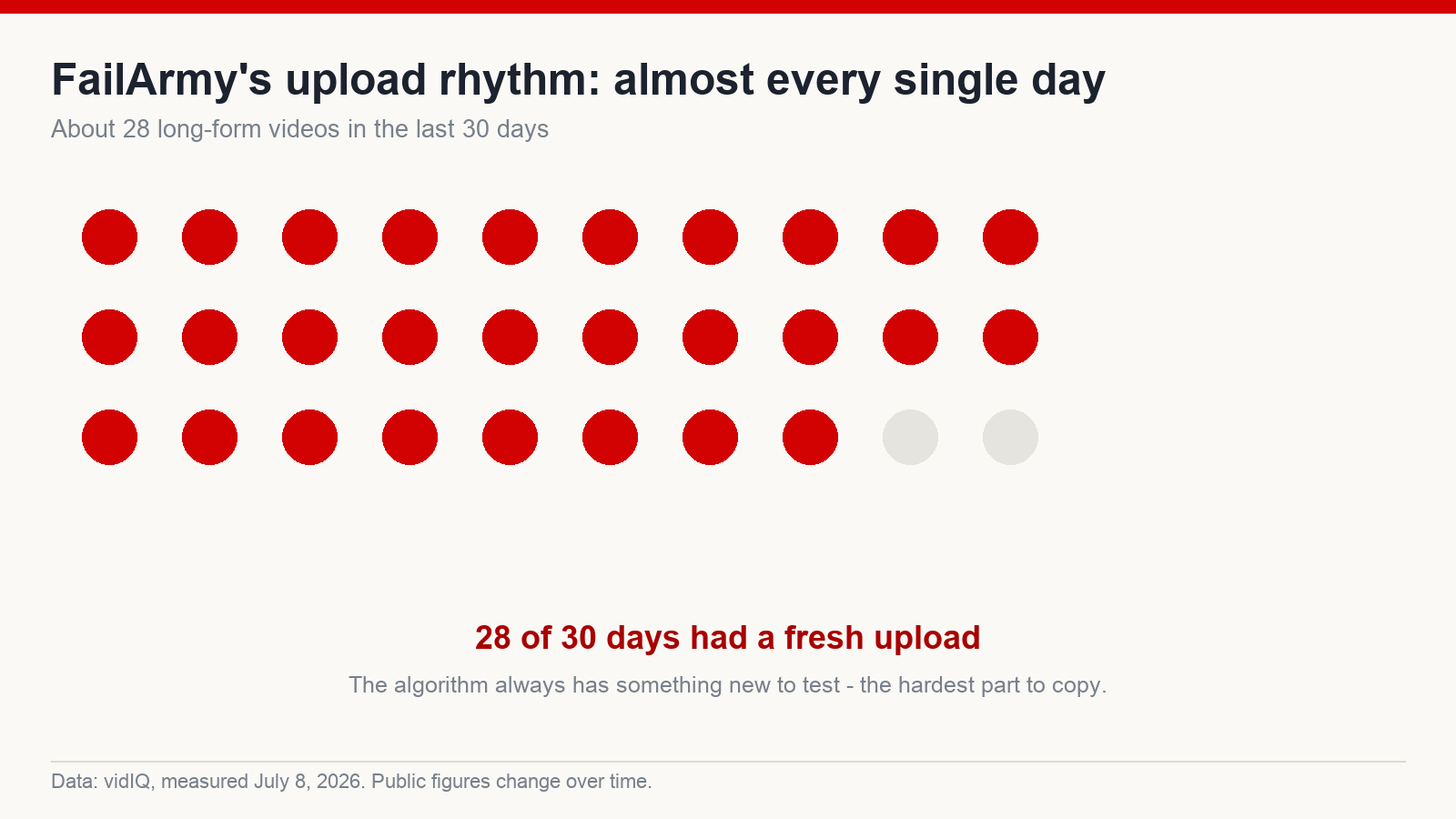
Over the most recent thirty days, the channel published around 28 long-form videos. Nearly one a day.
Do you see it? This is not a channel waiting on one brilliant upload. This is a channel handing the algorithm a fresh product to sell every single morning. YouTube’s recommendation system behaves like a street vendor: it can only sell what you hand it. Go silent for three weeks and it has nothing of yours to offer anyone.
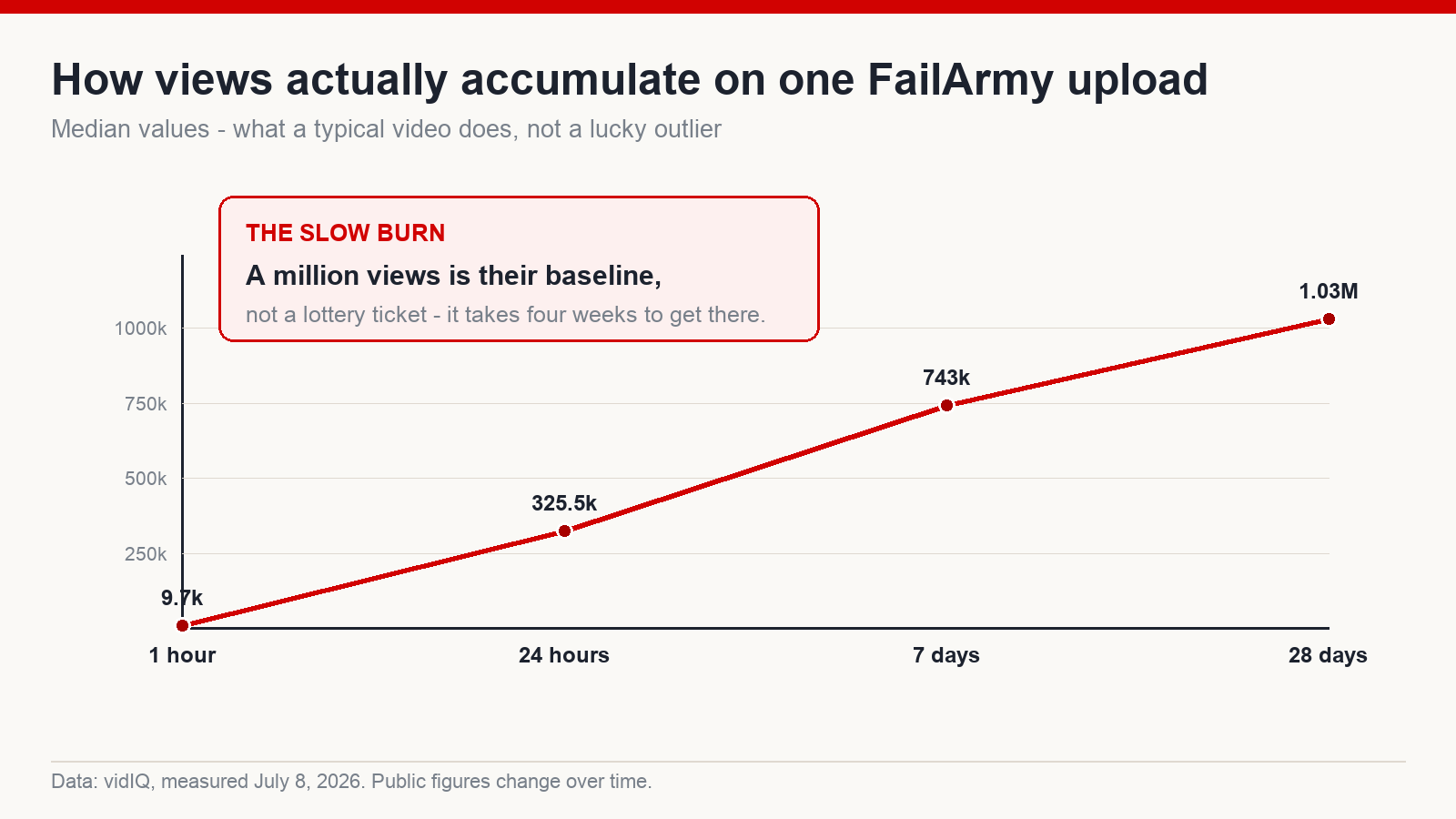
Now look at what happens to an ordinary FailArmy upload after publication. In the first hour it averages around 9,700 views, which sounds modest. By the 24-hour mark the median has reached 325,500.
Let me pause on the word median, because it matters. It is not the average, which gets dragged upward by a handful of monsters. The median is the value in the middle: half the videos do better, half do worse. So this is what a typical upload does, not a fluke.
And the typical figure at 28 days? A median of 1,031,000 views. Over a million.
Read that slowly. An ordinary FailArmy video crosses a million views in about four weeks. Not an explosion, not a viral miracle, just their normal. The strongest video that month landed near 4.85 million.
Two things to take from this. First, a video needs time to ripen. It keeps drawing views across a full four weeks, so do not bury it on day three and mutter that it died. Second, do not stake your entire future on one upload. That million does not come from a bomb going off. It comes from putting something into the pipeline day after day so the machine always has material to test.
And here is the interesting part: that constant stream of material is not rebuilt from scratch each time.
One asset, many outputs: how a single compilation gets recycled
There is a misconception about channels like this that quietly destroys new creators. They assume every upload means starting over: hunt for new material, edit from zero, push it out, forget it, repeat tomorrow. Run like that and you will be finished in three weeks. I know, because I ran exactly like that.
The truth is the reverse. A compilation, meaning many short segments assembled into one long video, does not die at publication. It multiplies.
Think about batch cooking. On a Sunday you make one large pot, not to eat in a single sitting but to portion out: lunch tomorrow, a container for work, one in the freezer for next week. One session at the stove covers several days. Nobody sane cooks a separate meal from scratch three times a day. That is exactly what this content model does.
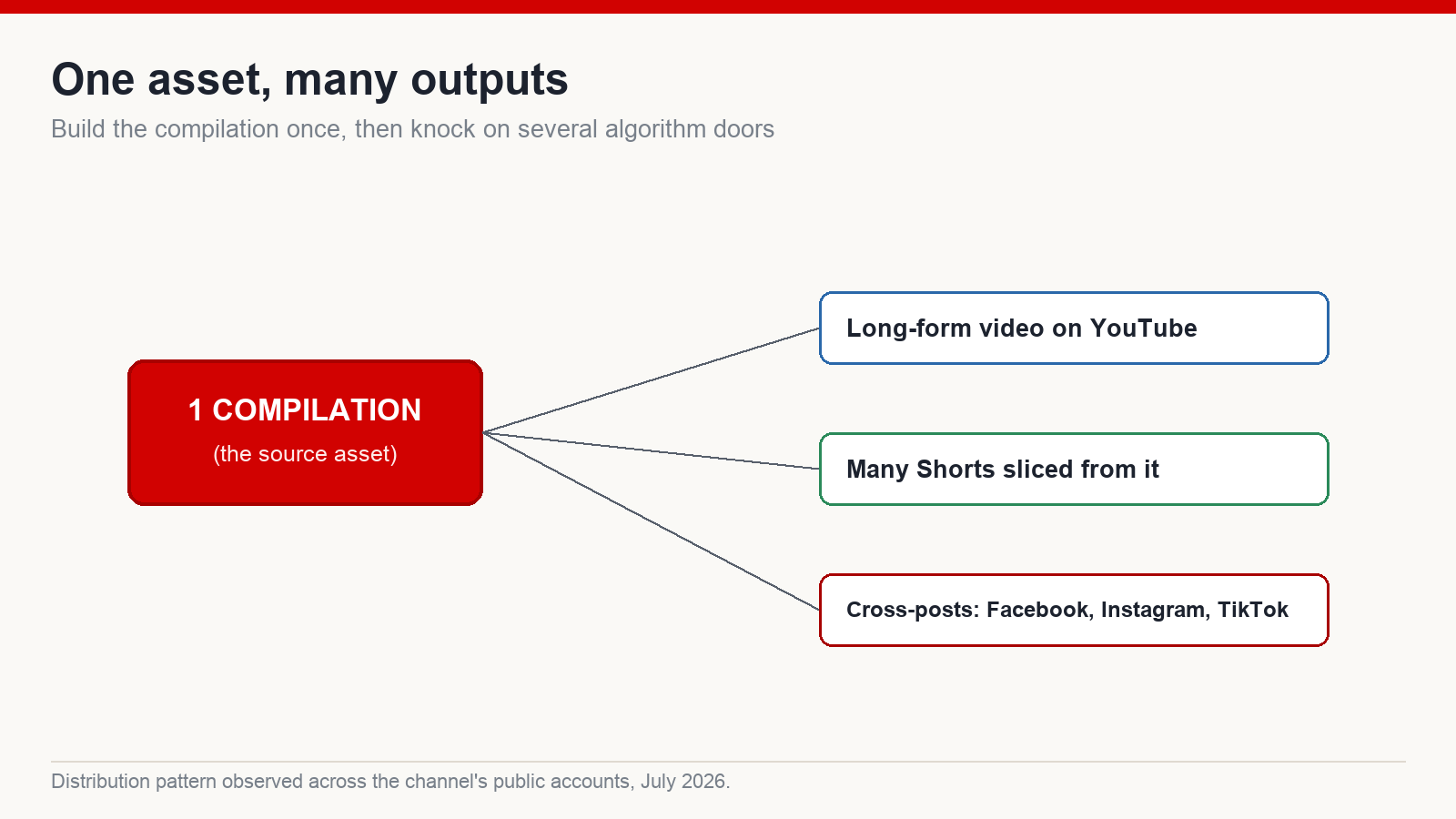
Look at the operation and it becomes obvious. The parent company, Jukin Media, now Trusted Media Brands, finishes a compilation and then pushes that same material everywhere: long-form on YouTube, Shorts cut from it for the vertical feed, posts on Facebook, Instagram and TikTok, even segments sold to broadcast television. On top of that, individual clips get licensed onward to news outlets and brands. One asset, more outputs than you can easily count.
The industry term is content repurposing: taking one original asset and reshaping it into several formats across several platforms. The mechanism that makes it work is simple. Every output knocks on a different algorithm’s door. Long-form YouTube, the Shorts feed, Reels, TikTok, these are separate audiences that barely speak to each other. When you sweat over an asset and then release it in exactly one place, you have personally shut five or six doors that were standing open.
The line I keep repeating to creators I work with: stop measuring yourself by how many videos you produce, and start measuring how many outputs you extract from each one. Exhausted people cook every meal from scratch. Durable people make one big pot.
And among all those outputs, there is one that beginners consistently dismiss while FailArmy treats it with real discipline.
Shorts published in batches: the back door most beginners ignore
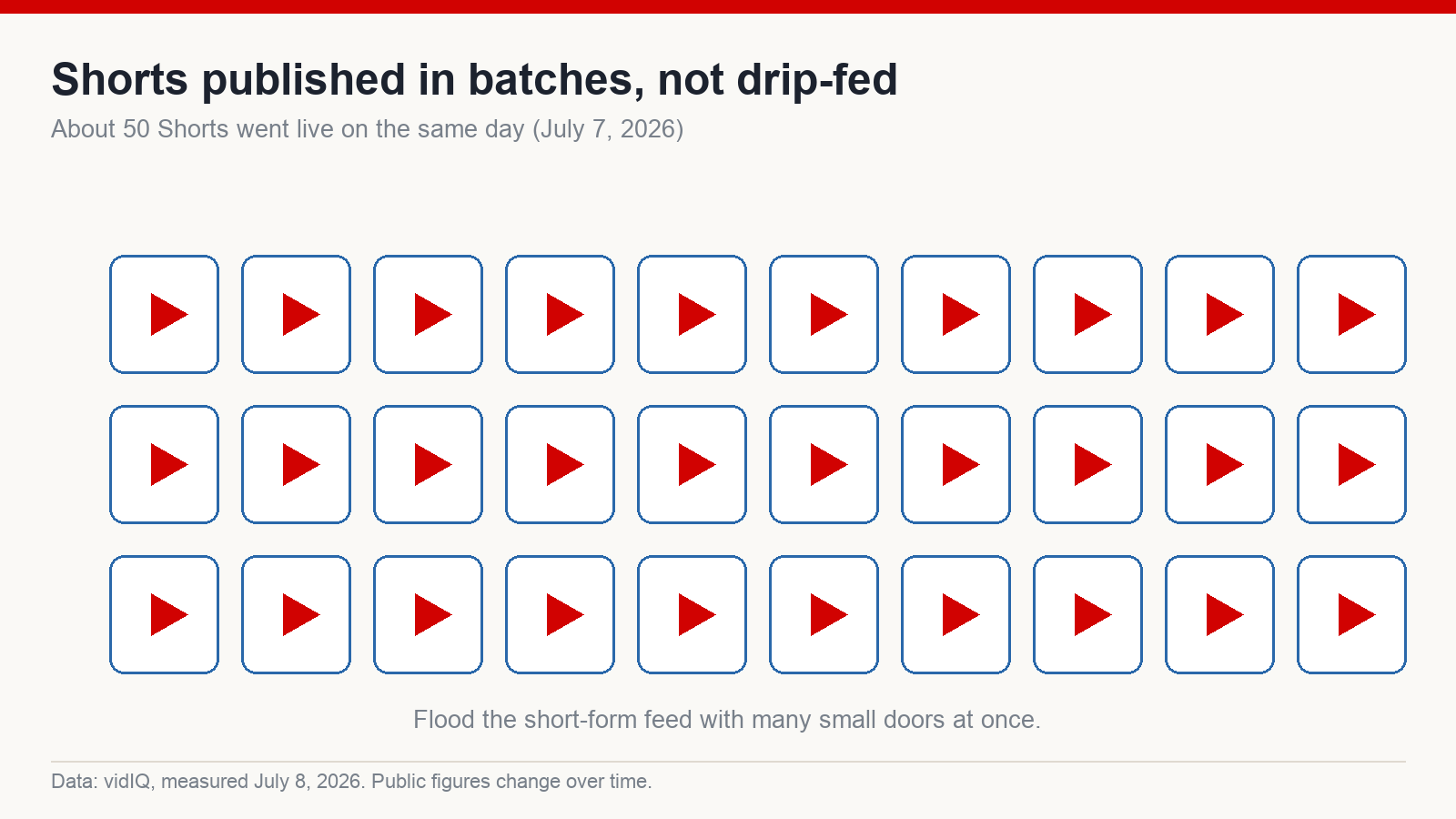
There is a detail in FailArmy’s behaviour that I suspect plenty of creators have noticed and then walked past. They do not drip-feed Shorts one a day. They dump them in batches. The data shows roughly 50 Shorts published against the same date, July 7, 2026. Fifty, in one go.
Why is a large batch smarter? Three reasons.
One: each Short is a line cast into the short-form feed, that endless surface where the algorithm keeps pushing people to swipe. Cast one line and you are relying on luck. Cast fifty at once and your odds change materially. You cover more surface, and the system has far more of your material to test.
Two: each Short is a door back into the long-form video. Somebody laughs at a twenty-second clip, gets curious, taps the channel name and lands on a ten-minute compilation. A Short is not a standalone product. It is a feeder into the asset that actually holds value.
Three, and this is my favourite part: those Shorts cost you almost nothing extra, because they are sliced out of material you have already built. By the time you finish a long-form video you are sitting on dozens of strong moments. Cut them out, one moment per Short. No new filming, no new concepts. Same pot, more containers.
The mistake I see constantly is treating Shorts as a side dish, published whenever the mood strikes. Do not. Shorts are an additional algorithmic surface fed by the same asset. Do them in batches, on a schedule, released in waves. That is how you actually use this back door.
But publishing consistently across many surfaces is worthless if the material itself expires in three days.
Consistency multiplied by evergreen equals compounding views
Here is the part that gets skipped: a publishing schedule only pays off when your material does not go stale by the weekend. Picture the big pot again, portioned into containers, except the food spoils by lunchtime. The portioning was pointless. Content behaves identically. Publish frantically every day with clips tied to a trend that dies overnight and you are on a treadmill: sweating hard, standing still.
FailArmy understands this at the bone. It does not chase what is hot. It picks evergreen material, meaning content that does not date: people falling, people making fools of themselves, moments of instant karma. What was funny in 2012 is still funny in 2026.
The proof still unsettles me. The Ultimate Girls Fail Compilation was uploaded in 2012. By July 2026, fourteen years later, it had reached 213,178,098 views. Published once, then collecting views for fourteen years like a tap nobody closed. That is not luck. That is durable material compounding over time.
The same intelligence shows up in the titles. One template used over and over: “Fails” and “Try Not to Laugh” repeated like a label. A year bolted on so each year produces a fresh edition without anybody inventing a new name. And a strong adjective layered on top, Insane, Expensive, Shocking, Idiots, so the headline carries its own charge.
Consistency multiplied by evergreen material is what produces compounding views. Drop either factor and you are running on the spot.
By now you are probably itching to start. Hold on. There is a boundary I need to draw clearly first, before enthusiasm turns into something reckless.
The copyright line: copy the SCHEDULE, never the SOURCE
FailArmy can gather other people’s clips and edit them together because Jukin Media, now Trusted Media Brands, has the budget to license each clip individually and a legal department to handle the paperwork. And you? Starting out, working alone, no lawyer. If you copy that specific behaviour, collecting other people’s viral clips and stitching them together, I will say it plainly: you are sharpening a blade and handing it to someone else. A single copyright strike means demonetization; a few more and the channel is gone. Months of work erased over one shortcut.
So take this instead: learn HOW FailArmy publishes, the consistency, the one-asset-many-outputs thinking, the emotional packaging, and never take WHAT it publishes. For raw material you walk the clean road. My rule has not changed: blend everything, go pure on nothing. Five sources per video: short fair-use excerpts under five seconds, licensed stock footage you actually paid for, footage you shoot yourself, AI-generated shots, and your own recorded audio. Stay away from broadcaster and studio footage. A little of each, nothing dominating the runtime. That is how somebody working with no budget still sleeps at night instead of waiting for a strike notification.
And the responsible caveat: fair use is not an absolute shield, and every platform and jurisdiction weighs it differently. Short excerpts, blended sources and genuine transformation reduce risk; they do not erase it. If you are not sure where a clip came from, the safe move is to leave it out. The clean road is slower, but you do not have to rebuild from zero after a strike.
Road cleared. Now the part you have been waiting for: fitting this machine into one pair of hands and one laptop.
Your one-person version: a weekly schedule and a one-session checklist
Reading all of this, you might be sighing. FailArmy publishes close to 28 long-form videos a month plus batches of around 50 Shorts. That is a team: editors, producers, a scheduler. And you are one person with a laptop and a few tired hours after work.
So let me say the thing that stops you tripping where I tripped: do not attempt 28 videos a month. Trying to match a team’s output with one pair of hands ends with burnout in three weeks and a quietly abandoned channel, which is exactly what my early years looked like: three days on, ten days off, then blaming myself for being lazy. You are not lazy. You are copying the wrong variable. What is worth copying from FailArmy is not the volume, it is the consistency. And to stay consistent alone, you do not replace people with people. You replace them with process discipline.
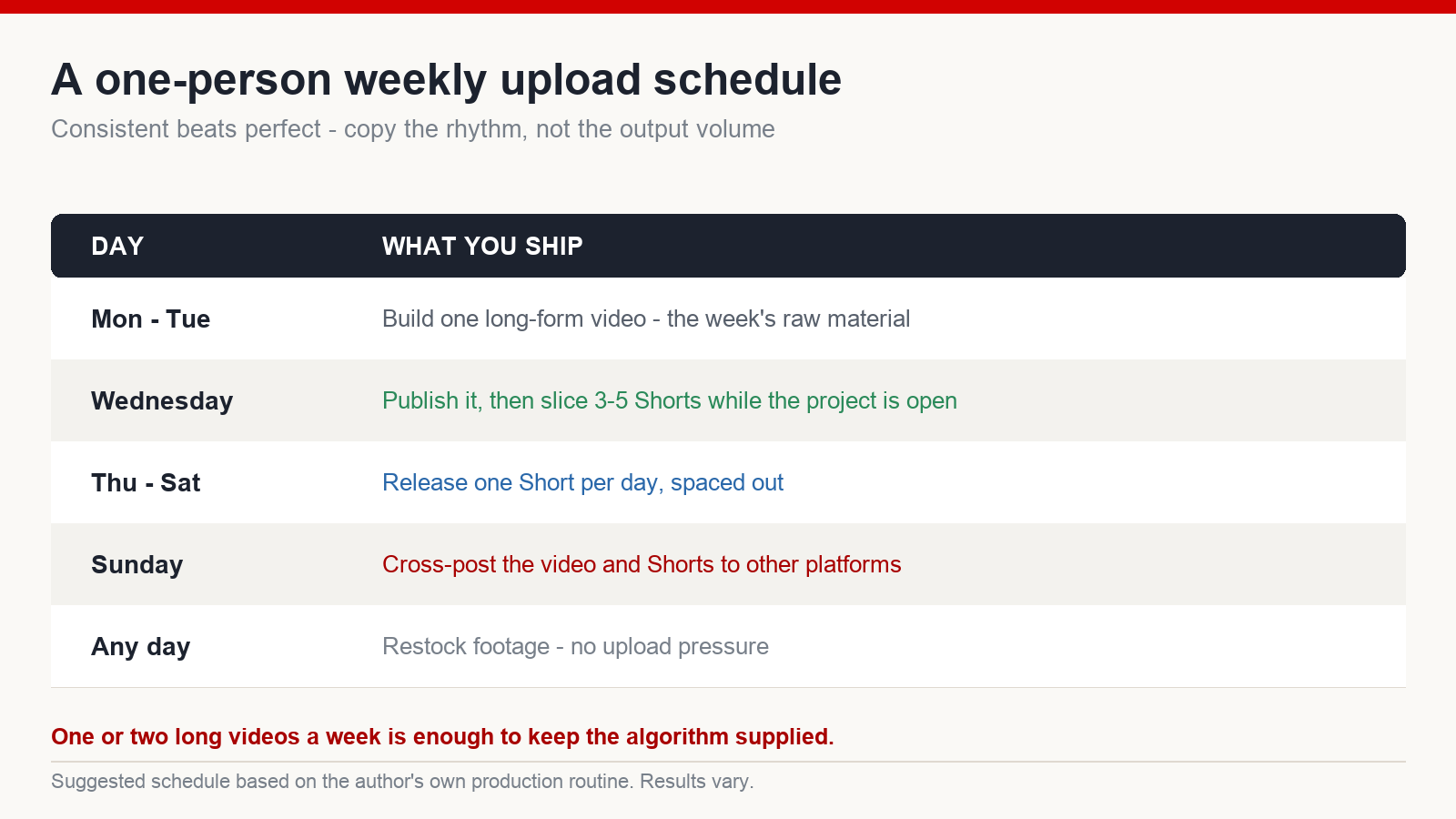
Here is a weekly schedule that fits a solo creator with a day job:
- Monday and Tuesday: build one long-form video. This is the week’s raw material.
- Wednesday: publish it, and slice 3 to 5 Shorts out of it immediately, while the project is still open.
- Thursday to Saturday: release the Shorts, one per day. Do not dump them in a single sitting.
- Sunday: cross-post the video and the Shorts to Facebook, TikTok and Instagram.
One or two long videos a week is enough to keep the algorithm supplied with something to test. And remember the number: an ordinary FailArmy upload needs a full 28 days to crawl to a million. Views do not arrive tomorrow. They arrive for the person still standing there four weeks later. Publishing consistently is how you remain standing.
And the one-session checklist. Sit down once, walk away with several outputs:
- Finish one long-form video from material you have already prepared.
- Cut 3 to 5 Shorts out of it. No refilming, no re-editing from scratch, just cutting.
- Schedule those Shorts across the coming days.
- Cross-post both the video and the Shorts to your other platforms.
One working session, four to six outputs. That is how a single person generates a team’s footprint: not by doing more, but by portioning one pot into several containers. You are not short on time. You are short on a checklist taped above your desk.
One more thing, for fairness. These figures come from a fifteen-year-old channel in the entertainment space with a largely American audience. Your channel is new, your niche is different, your audience is different, and your view curve will almost certainly sit well below theirs in the early stages. The thing worth copying is not the million-view number. It is the structure of the machine. The numbers are theirs. The discipline can be yours.
Back to my friend: a machine beats a miracle
Remember the friend from the top, the one who wondered whether he was cut out for this? Here is what I wanted to tell him, and what cost me about four years to learn.
I spent those years hunting for a genius video. One explosion that would do the work of thirty uploads. So I would sit on an ambitious project, finish it, and pray it went viral. It did not. Then I would sit and wait for the next chance. Years went by like that.
FailArmy does not win through miracles. It wins with a machine: one asset split into many outputs, published almost daily, built from evergreen material so the views compound. Their ordinary video reaches a million in four weeks, not because of luck, but because the pipeline never runs dry.
You are not short on talent. You are short on a machine. So was I, until I rebuilt my process properly and accepted that the results would arrive slowly, on the back of a system, rather than in one dramatic night.
So here is what I would ask you to do today, before you close this page: open your calendar and block two fixed sessions this week, treated as immovable. Take one long video you already have, cut 3 to 5 Shorts out of it, and space them across the coming days. Small. But that is the moment your machine turns over.
I pulled the whole machine apart in the companion piece, the full FailArmy breakdown, if you want the business model and the copyright boundary in detail.
Frequently asked questions
How many YouTube videos a week should a beginner publish?
Do not look at FailArmy’s near-28-videos-a-month rhythm and panic; that is a team’s output. For one person with a day job, one or two long-form videos a week plus a handful of Shorts sliced from them is sustainable and enough to keep the algorithm supplied. What matters is not the quantity, it is not skipping weeks.
How much does posting frequency matter compared with video quality?
Both matter, but they solve different problems. Consistency keeps the algorithm from forgetting you, because there is always something new to test. Quality and evergreen value determine how long a video keeps earning after it gets tested. Publishing daily with material that expires in three days is just exhausting. You need both halves.
Does repurposing content into Shorts and other platforms count as duplication and cost me views?
No, because each platform runs a separate algorithm serving a largely separate audience. A long-form video, a Short cut from it and a TikTok version knock on different doors. Slicing Shorts out of the long-form video also creates a path back to your main asset. This is leverage, not duplication.
Are five-second fair-use excerpts definitely safe from copyright claims?
Nothing is definitely safe. Short excerpts, blended sources and genuine transformation lower the risk rather than removing it, and every platform and jurisdiction judges it differently. If you cannot verify where a clip came from, the safest move is to leave it out. FailArmy can use whole clips because it licenses them and employs lawyers, which is exactly the part a beginner should not imitate.
About the author
I am Phuc, a YouTube trainer. I have been building on the platform since 2017, nine years, and I now spend most of my time teaching other people how to do it.
My core specialism is faceless channels built for English-speaking audiences, primarily in the US, UK, Germany and Japan, where advertiser rates tend to run higher than in my home market. Everything above comes out of running that model rather than reading about it.
My own path was not the tidy version. Roughly four years of teaching myself and failing, a full rebuild of my process, then a long slow climb where results only compounded because there was a system underneath. I mention it so you know the advice here was paid for with real tuition, not borrowed from somewhere else. If you want the step-by-step version of that system, it lives at mmoyoutube.com.
Disclaimer: this article shares personal experience, not legal advice or any promise of income. Outcomes on YouTube vary by niche, skill and timing, and platform policies change. The FailArmy figures belong to that channel alone and are not a level you should expect to reach; they were measured with vidIQ on July 8, 2026. For copyright questions where certainty matters, consult a qualified legal professional.